Visibility: clouded by egg nog
Temperature: warm at heart
Location: under the Mistletoe
Equipment: christmas tree
Merry Christmas
2013 has been a fun flying year for yours truly. It started out with dual time in the 172. I trained radio navigation and passed the check ride “Controlled Visual Flight“. As soon as I had the new license in the mail, I used it to get lost on a short hop in bad weather.
Speaking of beauties, I met another exciting lady. LISA is one of the airplanes that is operated by “Pilot & Flugzeug” magazine. She is available for rent and I liked her when I got checked out on her. We have not flown together all that much but I am looking forward to more trips in 2014.
My home base of EDAY must like the light sports crowd. That is the only explanation for the tower controllers presence at 4 o’clock in the morning. On the day of the shortest night, VFR pilots in Strausberg go nuts and embrace the sun with a flight into the sunrise. I can hardly wait to repeat this great experience this year!
We saw a few technical problems on the blog this year. This got me thinking and as a first step, I have registeresd a new URL. aloft.aero is where you can find me in the future – wether it will be with blog.com or somewhere else (plus a .aero-domain is really cool!)
I love podcasts and there are a lot of them out there. In 2013, I gave feedback and made comments and this blog was featured a few times. In May, Captain Jeff of the Airplane Pilot Guy podcast linked me after I gave feedback and in November I had a question for him. In October, I had a chance to sub for David Vanderhoof as the Airplane Geeks historian on the Airplane Geeks Podcast. I choose to write about the Mooney M20, as I am a bit of a Mooniac.
For 2014, I have great plans already. What would be a new year without a new rating! And my list for new destinations is getting longer almost daily.
I wish you all a great New Year. Have fun, be safe and go out and fly!
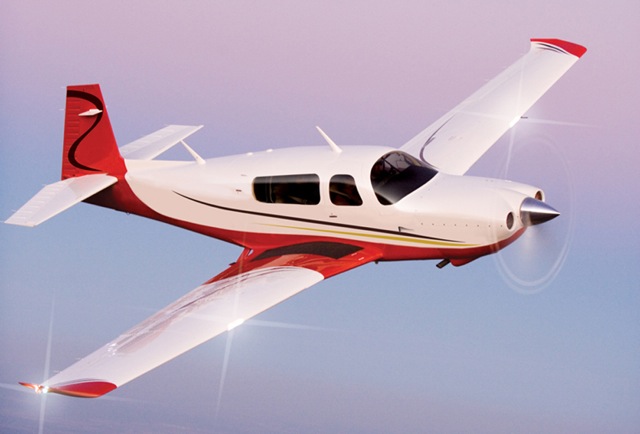
The Mooney Aviation Company of Kerrville, Texas is the manufacturer of the very fast, very efficient M20 family of single engine aircraft. After a long period of “hibernation”, I was very excited to hear that they found a new investor and Mooney is gearing up to resume production!
I am a dry Mooniac – a fan of Mooney airplanes although I sadly don’t fly one myself. Recently I did some research on the history of the Mooney M20 family. I was inspired by David Vanderhoof of the Airplane Geeks Podcast (airplanegeeks.com) and it was a lot of fun!
Here is my history of the M20. To hear it on the Airplane Geeks Podcast, go toEpisode 271 on their website. You should also subscribe to the podcast – it’s great!
Mooney M20 – Speed and efficiency
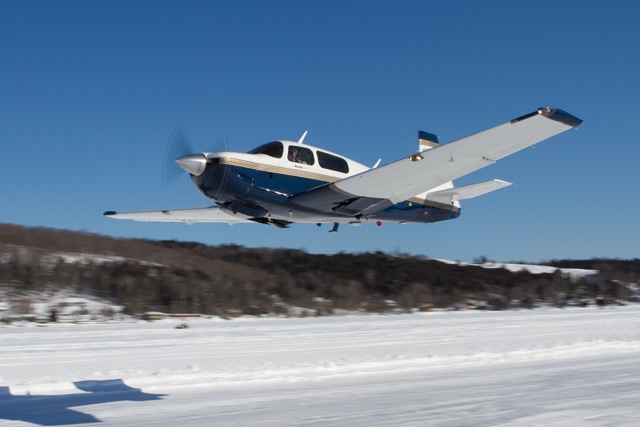
Mooney M20 low pass
The world of aviation has always been fueled by passion. Al Mooney and his brother Art have been a major source for pilots’ dreams of speed and efficiency for more than 60 years.
Born in 1906, Al Mooney grew-up being fascinated with everything flying. He started to work for different airplane manufacturers in Kansas and quickly became a successful aircraft designer. But Al wanted more. He had a vision for a new aircraft, a sports plane with the heart of a fighter, fast and efficient.
After a failed attempt in 1929, the second Mooney Aircraft Company was founded in 1946. Their first product was the M18 “Mite”. A single seat, low wing trainer that already combined the trademark qualities of speed and efficiency. But Al had only just started.
M20
The Mooney M20 was the next big step, a family of four seat, single engine, piston aircraft. In production since 1955, the M20 is one of the legacy GA aircraft types. Some 11.000 M20s in a dozen or more variants have been built and are operated by advanced private pilots and small companies.
Mooney M20s are very recognizable as all models share the signature tail. The leading edge is completely vertical, creating a very distinctive look. But there is more to the tail then just looks. Instead of using conventional trim tabs, the entire tail pivots. This changes the angle of attack of the vertical stabilizers for trimming the aircraft in flight.
This seemingly complicated method is an original design feature of the M20 family and is a big factor in the airplanes very stable flight characteristics.
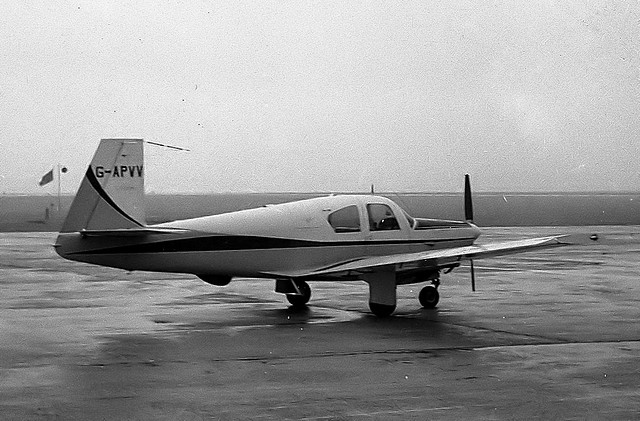
1960 M20 (Photo by Phillip Capper)
Most variants of the M20 have retractable landing gears. Early models had a manual retraction mechanism, operated by a Johnson bar. Timing and speed was critical for the operation and the safe retraction required some practice. An electric system replaced the Johnson bar from 1967 on. The design of the landing gear is very sturdy and uses rubber disks as dampeners, creating a fail proof, cost efficient and easy to service system.
The first Mooneys had wooden tails and sleek, wooden wings. After problems with stability and durability, most aircraft have been retrofitted with metal tails. From about 1960 on, the wings of all M20s have been built around a single tip-to-tip aluminum wing spar, eliminating the earlier wooden construction. The heavy-duty wing spar is an important factor for the good safety record of the M20.
The original M20 was powered by a 150 horsepower Lycoming O-320, followed by a 180 horsepower O-360 in the M20A of 1958.
Larger and farther
In 1964, Mooney introduced the M20E with a fuel injected, four cylinder Lycoming O-360 engine with 200 horsepower. While all Mooneys had been fast compared to their peers from Cessna and Piper, the M20E was the first true high performance Mooney.
With the Mooney M20F “Executive” of 1966, the company responded to the customers demand for more room. The “Executive” had a stretched fuselage and an additional window. The aircraft was slower than the short fuselage version but offered more room, larger tanks and more payload. The “Executive” was able to carry four passengers over a thousand miles.
Speedbird
1977 was one of the most notable years for Mooney. The company hired “Mr. Fast” – aerodynamics expert Roy LoPresti as vice president for engineering. He designed the M20J “201″, one of the most successful models in company history and the first GA aircraft to fly 200 miles per hour on 200 horsepower. An achievement that is noteworthy until today. Many Mooniacs consider the “201” to be the best Mooney ever. It clearly hit a sweet spot of speed and efficiency.
Hard to handle
The M20K was the first Mooney with 6 cylinder engine. The powerful Continental TSIO-360 had cooling problems in the small Mooney cowling. It required special care and modified climb pattern in hot conditions and was one of the reasons behind the M20s reputation for being demanding. The combination of engine and airframe could be a challenge for the typical private pilot in a time before computers were there to help with the engine management.
Mooney and Porsche
When Porsche entered the GA stage in 1985, their PFM 3200 engine seemed to be a perfect match for the M20. The 210 horsepower rating fit the requirements, the single lever operation of the electronically managed engine took care of any handling problems and the name Porsche resonated speed, quality engineering and luxury.
Unfortunately Porsche decided not to stay in the market for long and only 40 M20PFMs were ever built.
One of the few M20 PFM
Critics say that in subsequent models too much emphasis was put on speed alone and that Al Mooneys philosophy of efficiency and economy became secondary. While this may be true, the Mooney Acclaim Type S of 2008 with a top speed of 242 knots still holds the record for the fastest piston single.
Recession
The Mooney Company was hit hard by the late 2000s economic down turn and has all but ceased operations. In 2013, most employees had been let go and no new aircraft are being built at present. However, the community of Mooney pilots, owners and lovers is still big and used birds are high in demand.
After a long break, Mooney has attended Airventure 2013 and there are new rumors about a Chinese investor. This Mooniac is not alone in hoping to see new M20s coming out of Kerrville soon!
To be continued…
M20TN Acclaim Type S (Picture Mooney Aviation Company, Inc.)
(originally posted on October 23, 2013 by tilbo at aloft.blog.com/mooney-m20-speed-and-efficiency/)
Boys like toys. And your average pilot has a hard time resisting a good toy. The Garmin company knows this – there is no other explanation for the recently announced “Garmin D2 Pilot Watch”.
A traditional pilot watches has large, illuminated hands, a stop watch and excessive amounts of bravado. But the “D2″ takes the term “Pilot Watch” to a new level entirely. It is a whole portable avionics suite with a wrist strap!
It features a bunch of useful functions. A barometric altimeter, a compass, various timers and – of course – GPS with moving map, airport directory and “nearest” feature. Basically everything you need to navigate after all other navigation aides in your airplane stopped working. And it even tells the time.
Discussing the usefulness of toys is always tricky and at times a bit unfair. But the “must have factor” for the average airplane geek is definitely high. And it will be available in time for Christmas, in case you are still looking for something for that special pilot in your life!
To be continued…
Garmin D2 pilot watch (Picture The Garmin Company)
(originally posted on October 20, 2013 by tilbo at aloft.blog.com/garmin-d2/)
Visibility: almost none
Temperature: 2°C
Wind: blowing sleet sideways
Location: local aviation administration
Equipment: Computer in the testing center – again
It has been gray for weeks. I don’t remember the last clear day. The last few days, even small IFR traffic stays on the ground as the low hanging clouds are full of ice. In this weather, it is best to leave the flying to the pros with the heavy iron.
For folks like me, this is the time of year for theory (or a flying vacation – but for now, that will remain a future blog post to dream of…).
I’m back at the local aviation administration. The testing office has become home turf over the course of the last few visits. The examiner greets me by name.
I’m here for the theory exam for Controlled Visual Flight (CVFR). This module is the last step I need to upgrade my national private pilots license to the international one. I feel well prepared. I used the same tutoring software that has led me through the previous theory exams. The subjects tested today are “Navigation”, “Air Law” and “Aircraft Performance”.
The test starts, I read the first question and I have never heard it before. Odd, the tutoring software was spot on in all previous test. The surprises continue. The questions are within the field I have learned but many of them are not from the database I have used. Judging by his face, the guy next to me has the same problem.
I use all of the allotted time to answer the questions and to check them. The challenge was pleasant, the result okay. “Aircraft Performance” was kind of close with 77%. “If you pass, nobody will ever ask again” is the examiners comment to that. I will see him again for the check ride…
To be continued…
(originally posted on January 11, 2013 by tilbo at aloft.blog.com/gray-as-in-grayt-time-for-theory/)
“Forget all that stuff about thrust and drag, lift and gravity, an airplane flies because of money.”
Flying is expensive. There are many ways to justify the cost or to calculate it in a way that makes it look cheaper. But the truth remains: flying is expensive!
Airlines operate under enormous financial pressure. That is why utilization of capacities is key for them. Over its life span, a long haul airliner typically spends more time flying than on the ground – including all of the maintenance time.
In the world of “General Aviation”, aircraft spend days or even weeks at a time on the ground. Privately owned aircraft often have a very small number of flight hours to calculate against the cost of maintenance or acquisition.
In flight schools or with commercial operators, the work load is often better. But then the operators profit margin enters the equation.
Liquid gold
No matter what type of aircraft – fuel is the biggest single cost factor. The piston engines of many GA aircraft are large and old fashioned. In the struggle between efficiency and reliability, the latter always wins. That is why engine manufacturers are very reluctant to adopt new technologies to make the engines more efficient. But in the times of 2,70 Euro per liter of Avgas (more than 12 US dollars per gallon!), it is difficult to accept that unburned liquid gold is used to regulate the internal cooling of the engine.
Flying is a great experience. But as long as it is so expensive, few private individuals fly. And as long as the number of pilots is small, the prices are high – it’s the classic catch 22.
Light Sports
The development of light sports aircraft is a big movement towards more affordability. The idea of deregulation of certain light aircraft in combination with limitations in performance and/or capabilities, exists in several countries. One of the earliest examples is the US model. Light sports aircraft can not exceed a maximum take off weight of 600 kilogram, they can not be complex (no retractable gear and no constant speed prop) and they can not fly faster than 120 knots.
In return, the license is easier and faster to get and there is no medical certificate required. A lot of maintenance can be done outside of a certified shop.
This simplification has lead to a very active community of sports pilots in the US. Some of them new pilots, enjoying the easier entry into flying, some of them private pilots, transitioning for the easier class.
Light Europe
The Joined Aviation Authorities (JAA) of 34 European states has been working on their own light sports regulations. Although inspired by the American model, the existing drafts have some very important differences. As the ELA-regulations (European Light Sports) are subsequently taking effect, the development over the next number of years is going to very interesting!
To be continued…
(originally posted on August 14, 2013 by tilbo at aloft.blog.com/money/)
Visibility: CAVOC, more than 10k
Temperature: 23°C
Wind: 140°, 6 knots
QNH: 1028hPa
Location: EDFE (Egelsbach)
Equipment: D-EFRV Cessna 172P
There is a lot of moisture in the early morning air but the sun is bright and the day promises to be nice. I am on my way to EDFE, Egelsbach. The airfield is one of the busiest for general aviation in the country. What makes it more demanding than others is its proximity to the very busy Frankfurt International Airport and the fact that corporate jets and piston single trainers co-exist here.
I’m in the area for a few days and decide to take an introductory flight with a local flight instructor. Who knows, I might come back here by air some day and a head start can’t hurt. It has been since the fall that I last flew a 172. But when I sit down I feel right at home. The instructor goes through the check list with me, we start up and go. The airport is not hugh but even this early it is buzzing with activity. There is even a seperate radio frequency for the ground traffic. I have never seen that at an uncontrolled airfield.
A smart looking black citation jet is starting up next to us. It is right behind us on taxiway Alpha to runway 09. The controller asks us if we can take the last but one ramp onto the runway (Foxtrot) and let the much faster jet pass and take-off before us. We are more than happy to comply and enjoy the front row view of the sleek beauty roaring past us and taking to the skies.
Cap at 1.500 feet
The traffic pattern at Egelsbach is in a relatively small box of airspace that is cut out of the controlled airspace of Frankfurt International Airport. The approach is routed through a set of compulsory reporting points and the maximum altitude is a mere 1.500 feet. The field itself is at 385 feet, so there is not a lot of safety margin over a woody area with hills rising to the south. It feels tight in a Cessna and I have to salute the jet pilots making this approach.
We leave the Egelsbach-box via Echo, turn south-west to pass Kilo and approach again via Delta 1 & 2. The base leg into runway 09 is very close to the controlled airspace and the instructor makes very sure we do not penetrate it.
We repeat the exercise a few more times until I start feeling comfortable. It was a good idea to do this with a local instructor and I am looking forward to my next visit – flying!
To be continued…
(originally posted on July 19, 2013 by tilbo at aloft.blog.com/flying-with-the-jets/)
The case of the dreadful crash landing of Asiana flight 214 in San Francisco has been in the news for days.
The cable news channels are under a lot of pressure to produce a constant stream of exciting new revelations, facts and turn of events. So much so that at times the quality of the story and the fact checking seems to be secondary.
A fine example is a recent story at Fox News affiliate KTVU in which the news lady announces that they have learned the names of the four pilots onboard the 777 jetliner – only to later find out that they had fallen victim to a prank.
As embarrassing (and funny) as this may be for KTVU and the poor news reading drone, it is also a result of an audience demanding more news all the time.
Yours truly, Captain Sum Ting Wong
To be continued…
(originally posted on July 14, 2013 by tilbo at aloft.blog.com/captain-sum-ting-wong/)
Visibility: light haze in the evening sun
Temperature: 25°C
Equipment: VC-25A
I live in the capital city and we have a lot of international guests. The city has a lot of routine in hosting the most important leaders from all over the world but todays guest is special even for us.
POTUS is in town. His entourage has flown in a few days ago already. A fleet of menacing looking C-17s arrived at the airport carrying cars, equipment and personnel in their bellies. The arrival of Air Force One itself was more of a calm event as all other air traffic was on hold for 20 minutes or more. So the beauty from Andrews AFB had the stage to herself.
Another big difference to other state visits is the no fly zone. For two days, there is no VFR flying 30 miles around the center of the big city. That means a mandatory break for almost all of the private pilots in the area. No wonder that not everybody welcomes the leader of the free world equally warm heartedly.
I like having him in town, although being grounded sucks!
To be continued…
(originally posted on July 5, 2013 by tilbo at aloft.blog.com/air-force-one/)
Visibility: light haze in the red dawn of the morning
Temperature: 16°C
Wind: 250°, 6 knots
QNH: 1021hPa
Location: EDAY (Strausberg)
Equipment: D-MALJ Rider MD3
The shortest night is one of the shortest nights for me. Last night we sat together at the BBQ telling stories about flights past, covertly glancing at the clock and not wanting to turn in just yet. The room in the pilots lounge is very comfortable. A shame that the bed will be used for a short nap only.
The morning is calm the breeze is gentle. The pilots are giddy like a bunch of school boys. The moment of truth is at 4 am. There is a draw for the honor of the first flight amongst the pilots. But then we find out that one of us has his birthday today. So he gets the first flight and the rest just finds buddies and airplanes.
Sunrise is at 4.43 am today, VFR flying is legal from sunrise -30 minutes. We are #3 aloft at 4.17 am (2.17 UTC for the log book). The morning is very calm and the flight is incredibly smooth. The sun is slowly coming up on the horizon when we turn back. There are other pilots waiting for their turn.
After touch down, we don’t taxi to apron but hand the aircraft over right there. A bunch of the others are by the side of the runway, chatting and taking pictures. Its quite a sight and I realize I have never walked on the pavement of the landing strip.
Breakfast is served at 6 am. We all have been up for hours and coffee and food is most appreciated. We conclude the morning with a group picture. On the way back, the roads are empty and I am home making coffee as the wife awakes.
Dear summer, I hope you stay for a long time after this welcome!
To be continued…
(originally posted on June 29, 2013 by tilbo at aloft.blog.com/summer-solstice/)