Mooney M20 – Speed and efficiency
Mooney is back!
The Mooney Aviation Company of Kerrville, Texas is the manufacturer of the very fast, very efficient M20 family of single engine aircraft. After a long period of “hibernation”, I was very excited to hear that they found a new investor and Mooney is gearing up to resume production!
I am a dry Mooniac – a fan of Mooney airplanes although I sadly don’t fly one myself. Recently I did some research on the history of the Mooney M20 family. I was inspired by David Vanderhoof of the Airplane Geeks Podcast (airplanegeeks.com) and it was a lot of fun!
Here is my history of the M20. To hear it on the Airplane Geeks Podcast, go toEpisode 271 on their website. You should also subscribe to the podcast – it’s great!
Mooney M20 – Speed and efficiency

The world of aviation has always been fueled by passion. Al Mooney and his brother Art have been a major source for pilots’ dreams of speed and efficiency for more than 60 years.
Born in 1906, Al Mooney grew-up being fascinated with everything flying. He started to work for different airplane manufacturers in Kansas and quickly became a successful aircraft designer. But Al wanted more. He had a vision for a new aircraft, a sports plane with the heart of a fighter, fast and efficient.
After a failed attempt in 1929, the second Mooney Aircraft Company was founded in 1946. Their first product was the M18 “Mite”. A single seat, low wing trainer that already combined the trademark qualities of speed and efficiency. But Al had only just started.
M20
The Mooney M20 was the next big step, a family of four seat, single engine, piston aircraft. In production since 1955, the M20 is one of the legacy GA aircraft types. Some 11.000 M20s in a dozen or more variants have been built and are operated by advanced private pilots and small companies.
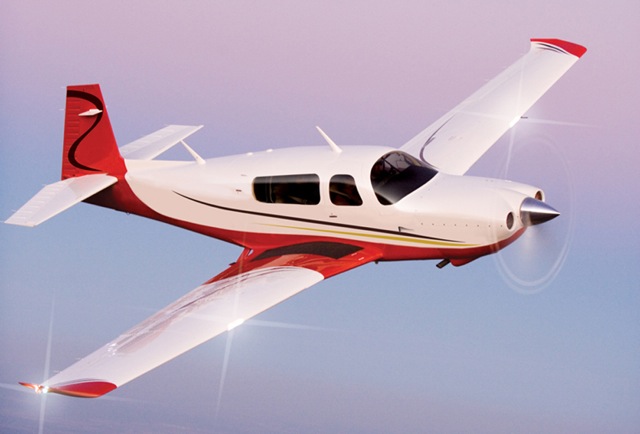
Mooney M20s are very recognizable as all models share the signature tail. The leading edge is completely vertical, creating a very distinctive look. But there is more to the tail then just looks. Instead of using conventional trim tabs, the entire tail pivots. This changes the angle of attack of the vertical stabilizers for trimming the aircraft in flight.
This seemingly complicated method is an original design feature of the M20 family and is a big factor in the airplanes very stable flight characteristics.
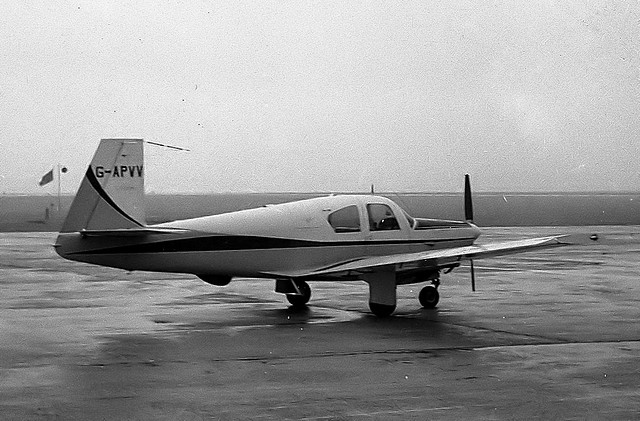
Most variants of the M20 have retractable landing gears. Early models had a manual retraction mechanism, operated by a Johnson bar. Timing and speed was critical for the operation and the safe retraction required some practice. An electric system replaced the Johnson bar from 1967 on. The design of the landing gear is very sturdy and uses rubber disks as dampeners, creating a fail proof, cost efficient and easy to service system.
The first Mooneys had wooden tails and sleek, wooden wings. After problems with stability and durability, most aircraft have been retrofitted with metal tails. From about 1960 on, the wings of all M20s have been built around a single tip-to-tip aluminum wing spar, eliminating the earlier wooden construction. The heavy-duty wing spar is an important factor for the good safety record of the M20.
The original M20 was powered by a 150 horsepower Lycoming O-320, followed by a 180 horsepower O-360 in the M20A of 1958.
Larger and farther
In 1964, Mooney introduced the M20E with a fuel injected, four cylinder Lycoming O-360 engine with 200 horsepower. While all Mooneys had been fast compared to their peers from Cessna and Piper, the M20E was the first true high performance Mooney.
With the Mooney M20F “Executive” of 1966, the company responded to the customers demand for more room. The “Executive” had a stretched fuselage and an additional window. The aircraft was slower than the short fuselage version but offered more room, larger tanks and more payload. The “Executive” was able to carry four passengers over a thousand miles.
Speedbird
1977 was one of the most notable years for Mooney. The company hired “Mr. Fast” – aerodynamics expert Roy LoPresti as vice president for engineering. He designed the M20J “201″, one of the most successful models in company history and the first GA aircraft to fly 200 miles per hour on 200 horsepower. An achievement that is noteworthy until today. Many Mooniacs consider the “201” to be the best Mooney ever. It clearly hit a sweet spot of speed and efficiency.
Hard to handle
The M20K was the first Mooney with 6 cylinder engine. The powerful Continental TSIO-360 had cooling problems in the small Mooney cowling. It required special care and modified climb pattern in hot conditions and was one of the reasons behind the M20s reputation for being demanding. The combination of engine and airframe could be a challenge for the typical private pilot in a time before computers were there to help with the engine management.
Mooney and Porsche
When Porsche entered the GA stage in 1985, their PFM 3200 engine seemed to be a perfect match for the M20. The 210 horsepower rating fit the requirements, the single lever operation of the electronically managed engine took care of any handling problems and the name Porsche resonated speed, quality engineering and luxury.
Unfortunately Porsche decided not to stay in the market for long and only 40 M20PFMs were ever built.

Critics say that in subsequent models too much emphasis was put on speed alone and that Al Mooneys philosophy of efficiency and economy became secondary. While this may be true, the Mooney Acclaim Type S of 2008 with a top speed of 242 knots still holds the record for the fastest piston single.
Recession
The Mooney Company was hit hard by the late 2000s economic down turn and has all but ceased operations. In 2013, most employees had been let go and no new aircraft are being built at present. However, the community of Mooney pilots, owners and lovers is still big and used birds are high in demand.
After a long break, Mooney has attended Airventure 2013 and there are new rumors about a Chinese investor. This Mooniac is not alone in hoping to see new M20s coming out of Kerrville soon!
To be continued…
(originally posted on October 23, 2013 by tilbo at aloft.blog.com/mooney-m20-speed-and-efficiency/)